
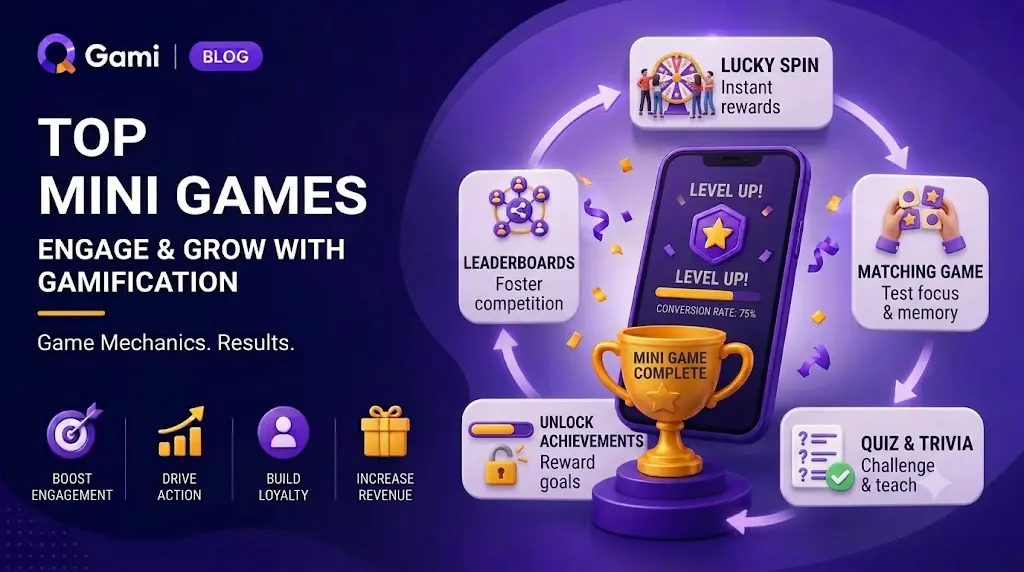
Popular Types of Mini Games in Gamification
Mini Games are one of the most popular tools when implementing Gamification for websites, apps, Loyalty programs, or Marketing campaigns.
Instead of simply asking users to perform an action, businesses can turn that action into an interactive experience through short games like Lucky Spin, Slot Machine, Memory Match, Sliding Puzzle, Quiz, Scratch Card, or Lucky Tree.
Mini Games don't need to be complex. A simple game with easy-to-understand rules, short interaction time, and appropriate rewards can still create significant motivation for users to participate and return.
In this article, let's explore the popular types of Mini Games in Gamification and how to choose them based on different objectives.
What is a Mini Game in Gamification?
Mini Games are games with simple mechanics, short play sessions, and are usually integrated into a larger product, platform, or Campaign.
In Gamification, Mini Games are typically not the end goal.
Instead, they are used as a behavior-driving mechanism.
For example:
User Action
     ↓
Play Mini Game
     ↓
Earn Points / Reward
     ↓
Unlock Benefit
     ↓
Return to Platform
     ↓
Repeat
A user might:
- Log in → receive game turns
- Complete a mission → unlock Lucky Spin
- Make a purchase → receive Scratch Card turns
- Answer a Quiz → earn Points
- Tend to Lucky Tree → unlock a Reward
This way, Mini Games become part of the Gamification Loop, helping connect user actions with rewards and business objectives.
1. Lucky Spin – The Spinning Wheel
Lucky Spin is one of the most popular Mini Games in Gamification.
Players perform a spin and receive a random result from a pre-configured reward list.
How it works
Users can earn spin turns after:
- Daily login
- Completing a mission
- Making a purchase
- Reaching a points milestone
- Sharing content
- Joining a Campaign
After spinning, the system determines the reward based on the Campaign configuration.
Example rewards
- 10% off voucher
- 20% off voucher
- 100 Points
- 500 Points
- Coupon
- Free Shipping
- Better luck next time
Best suited for
- E-commerce
- Retail
- Loyalty & Membership
- Fintech
- Marketing Campaign
- Customer Engagement
Why is Lucky Spin so popular?
Lucky Spin's advantage is that it is very easy to understand and requires almost no instructions.
The anticipation of waiting for the result also creates excitement, motivating users to take action to earn more turns.
2. Slot Machine
Slot Machine simulates the slot machine mechanic with multiple result reels spinning simultaneously.
Players activate the game and wait for the symbols to stop to determine the reward.
Example:
🍒 | ⭐ | 🎁
If a special combination appears:
🎁 | 🎁 | 🎁
the player can receive a larger reward.
Possible implementations
- Matching 3 symbols
- Matching 2 symbols
- Jackpot
- Random Reward
- Bonus Round
Best suited for
- Retail
- E-commerce
- Loyalty
- Promotional Campaign
- Brand Activation
Strengths
Slot Machine creates a very clear sense of anticipation: users watch the symbols spin and wait for the final result.
3. Memory Match
Memory Match requires players to memorize the positions of cards and find matching pairs.
Example:
┌─────┬─────┬─────┬─────┐
│  ?  │  ?  │  ?  │  ?  │
├─────┼─────┼─────┼─────┤
│  ?  │  ?  │  ?  │  ?  │
└─────┴─────┴─────┴─────┘
Players flip two cards at a time.
If they match:
🎁 ↔ 🎁
→ Match!
If they don't match:
🎁 ↔ ⭐
→ Try again
Customizable content
Businesses can replace the images on cards with:
- Brand logo
- Products
- Characters
- Campaign imagery
- Reward icons
- Educational content
Best suited for
- Education
- Brand Awareness
- Product Discovery
- Marketing Campaign
- Training
Strengths
Memory Match can combine entertainment with Brand Awareness, helping users remember product or brand imagery while playing.
4. Sliding Puzzle
Sliding Puzzle is a Mini Game that requires players to move puzzle pieces to form an image or arrange them in the correct order.
Example:
┌─────┬─────┬─────┐
│  1  │  2  │  3  │
├─────┼─────┼─────┤
│  4  │  5  │  6  │
├─────┼─────┼─────┤
│  7  │  8  │     │
└─────┴─────┴─────┘
Usable images
- New products
- Brand logo
- Characters
- Event imagery
- Campaign Key Visual
- Reward imagery
Best suited for
- Brand Awareness
- Product Marketing
- Education
- Marketing Campaign
- Customer Engagement
Strengths
Unlike Mini Games that rely heavily on luck, Sliding Puzzle creates a clearer challenge and skill-based engagement.
5. Lucky Tree
Lucky Tree is a Mini Game that combines Progression and Reward.
Players perform actions to help the tree grow. Upon reaching a certain milestone, the tree can yield rewards.
        🌳
       🌳🌳
      🌳🌳🌳
        │
      ─────
Players can:
- Water the tree
- Collect energy
- Complete missions
- Receive care turns
- Collect items
- Wait for the tree to grow
Upon reaching a milestone, players can receive:
- Points
- Voucher
- Coupon
- Gifts
- Badge
- Unlock Reward
Best suited for
- Loyalty
- Membership
- Daily Engagement
- Customer Retention
- Long-term Campaign
Strengths
Lucky Tree has the ability to create a Progression Loop.
Instead of playing once and finishing, users have a reason to return every day to continue growing the tree and progress toward the next reward.
This is the key difference between Lucky Tree and instant reward style Mini Games like Lucky Spin or Scratch Card.
6. Quiz
Quiz is one of the most popular forms of Gamification, especially in Education, Marketing, and Customer Engagement.
Players answer questions and earn points based on their results.
Example
Which product belongs to the latest product line?
- A. Product A
- B. Product B
- C. Product C
- D. Product D
Players can receive:
- Points
- XP
- Badge
- Coupon
- Voucher
- Extra Game Turn
Best suited for
- EdTech
- Training
- Product Education
- Brand Awareness
- Marketing Campaign
Quiz is especially suitable when businesses want to combine Gamification with knowledge or information delivery.
7. Scratch Card
Scratch Card simulates the experience of scratching a card to reveal a hidden reward underneath.
┌─────────────────────┐
│                     │
│    SCRATCH HERE     │
│                     │
│                     │
└─────────────────────┘
Players perform the scratch action to reveal their reward.
Possible rewards
- Discount
- Voucher
- Points
- Coupon
- Free Shipping
- Gifts
Best suited for
- E-commerce
- Retail
- Promotion
- Loyalty
- Flash Campaign
Strengths
Scratch Card leverages the elements of curiosity and reveal.
Users know that a reward is hidden but don't know exactly what it is, creating motivation to complete the scratch action.
8. Pick a Box
Pick a Box lets players choose one of several boxes or objects to discover a reward.
┌───────┐  ┌───────┐  ┌───────┐
│   1   │  │   2   │  │   3   │
└───────┘  └───────┘  └───────┘
Each choice may contain a different reward.
Best suited for
- Marketing Campaign
- Promotion
- Loyalty
- E-commerce
- Brand Activation
The appeal of this mechanic lies in the combination of:
Choice → Mystery → Reveal → Reward
9. Pick & Reveal
Pick & Reveal is a group of Mini Games based on the behavior of choosing before knowing the outcome.
Players can choose from:
- Lucky envelopes
- Balls
- Boxes
- Playing cards
- Cups
- Mystery tiles
Example:
🍀  🍀  🍀  🍀  🍀
 ↓
🎁 Reward
This mechanic is especially suitable for Campaigns that want to create a sense of mystery and anticipation while keeping gameplay extremely simple.
10. Reaction Game
Reaction Game requires players to respond quickly to an event appearing on screen.
Example:
⚪ ⚪ 🔴 ⚪ ⚪
        ↑
      TAP!
Some popular variants:
- Tap the Target
- Tap Fast
- Reaction Test
- Avoid the Object
- Catch the Item
Best suited for
- Brand Activation
- Event
- Marketing Campaign
- Mobile Marketing
- Social Engagement
Strengths
Reaction Game has a very short play time, making it suitable for Campaigns where businesses want to maximize the number of participating users rather than requiring them to play for a long time.
Comparing Mini Game Types
| Mini Game | Core Mechanic | Luck | Skill | Engagement |
|---|---|---|---|---|
| Lucky Spin | Random Reward | ⭐⭐⭐⭐⭐ | ⭐ | ⭐⭐⭐⭐ |
| Slot Machine | Random + Matching | ⭐⭐⭐⭐⭐ | ⭐ | ⭐⭐⭐⭐ |
| Memory Match | Memory | ⭐ | ⭐⭐⭐⭐ | ⭐⭐⭐⭐ |
| Sliding Puzzle | Puzzle | ⭐ | ⭐⭐⭐⭐⭐ | ⭐⭐⭐⭐ |
| Lucky Tree | Progression | ⭐⭐ | ⭐⭐ | ⭐⭐⭐⭐⭐ |
| Quiz | Knowledge | ⭐ | ⭐⭐⭐⭐ | ⭐⭐⭐⭐ |
| Scratch Card | Reveal | ⭐⭐⭐⭐⭐ | ⭐ | ⭐⭐⭐⭐ |
| Pick a Box | Choice + Reveal | ⭐⭐⭐⭐⭐ | ⭐ | ⭐⭐⭐⭐ |
| Pick & Reveal | Choice + Mystery | ⭐⭐⭐⭐⭐ | ⭐ | ⭐⭐⭐⭐ |
| Reaction Game | Reflex | ⭐ | ⭐⭐⭐⭐⭐ | ⭐⭐⭐⭐ |
Note: The levels of "Luck", "Skill", and "Engagement" are relative. Actual effectiveness depends on gameplay, rewards, UX, and how the Mini Game is connected to the Gamification Loop.
Which Mini Game Should You Choose for Gamification?
There is no single Mini Game that fits every Campaign.
Businesses should start from their business objectives and the behavior they want to drive, then select the gameplay accordingly.
| Objective | Recommended Mini Game |
|---|---|
| Boost quick engagement | Lucky Spin, Scratch Card |
| Increase return rate | Lucky Tree |
| Create a sense of luck | Lucky Spin, Slot Machine |
| Increase Brand Awareness | Memory Match, Sliding Puzzle, Quiz |
| Educate users | Quiz, Memory Match |
| Increase time on platform | Sliding Puzzle, Memory Match |
| Short-term Campaign | Lucky Spin, Scratch Card, Pick a Box |
| Loyalty / Membership | Lucky Tree, Lucky Spin |
| Product Discovery | Memory Match, Puzzle, Quiz |
| Event / Activation | Reaction Game, Pick & Reveal |
Mini Games Are More Than Just "Play"
A common mistake when implementing Gamification is treating Mini Games purely as a form of entertainment.
In an effective Gamification system, Mini Games should be designed as a behavior-driving mechanism.
Example:
Complete 3 Missions
        ↓
Receive 1 Lucky Spin
        ↓
Earn 500 Points
        ↓
Redeem Points for Voucher
        ↓
Return to Platform
        ↓
Continue Completing Missions
In this case, Lucky Spin is not the end goal.
It acts as a Reward Mechanism sitting between the user's action and their reward.
This is exactly how Mini Games become part of the Gamification Loop.
What Should Mini Games Be Combined With?
To create long-term value, businesses can combine Mini Games with other Gamification mechanics.
🎯 Missions
Users complete missions to earn game turns.
⭐ Points
Mini Game results can award Points for users to accumulate.
🏆 Leaderboards
Scores from Mini Games can be used to compete on leaderboards.
🎁 Rewards
Mini Games can become the distribution mechanism for Vouchers, Coupons, or gifts.
📈 Progression
Users can unlock new Mini Games, levels, or rewards as they progress.
🔥 Streaks
Maintaining login or action streaks earns additional game turns.
🎟️ Campaigns
Mini Games can be activated within a Campaign with a specific start and end date.
Conclusion
Mini Games are one of the simplest and most effective ways to bring Gamification into a website, app, Loyalty program, or Marketing Campaign.
From luck-based mechanics like Lucky Spin, Slot Machine, Scratch Card to skill-oriented games like Memory Match, Sliding Puzzle, Quiz, each type of Mini Game can serve a different objective.
The key is not choosing the "best" Mini Game, but choosing the mechanic that best fits the behavior the business wants to drive.
An effective Gamification system can combine:
- 🎯 Missions
- ⭐ Points
- 🏆 Leaderboards
- 🎁 Rewards
- 📈 Progression
- 🔥 Streaks
- 🎟️ Campaigns
- 🎮 Mini Games
to form an engagement loop capable of attracting, motivating, and retaining users over the long term.
Mini Games are the tool. The Gamification Loop is what creates the value.
Explore Gamification with QGami
Businesses don't need to build an entire Gamification system from scratch.
QGami provides a Gamification platform that helps businesses integrate Mini Games, Points, Rewards, Missions, and engagement mechanics into their products or Campaigns.
From a simple game like Lucky Spin to a full Gamification system, businesses can design experiences tailored to their goals of Engagement, Loyalty, and Customer Retention.
What gamification✦✦ solution are you looking for?
We are ready to advise the most suitable solution for your business model.