
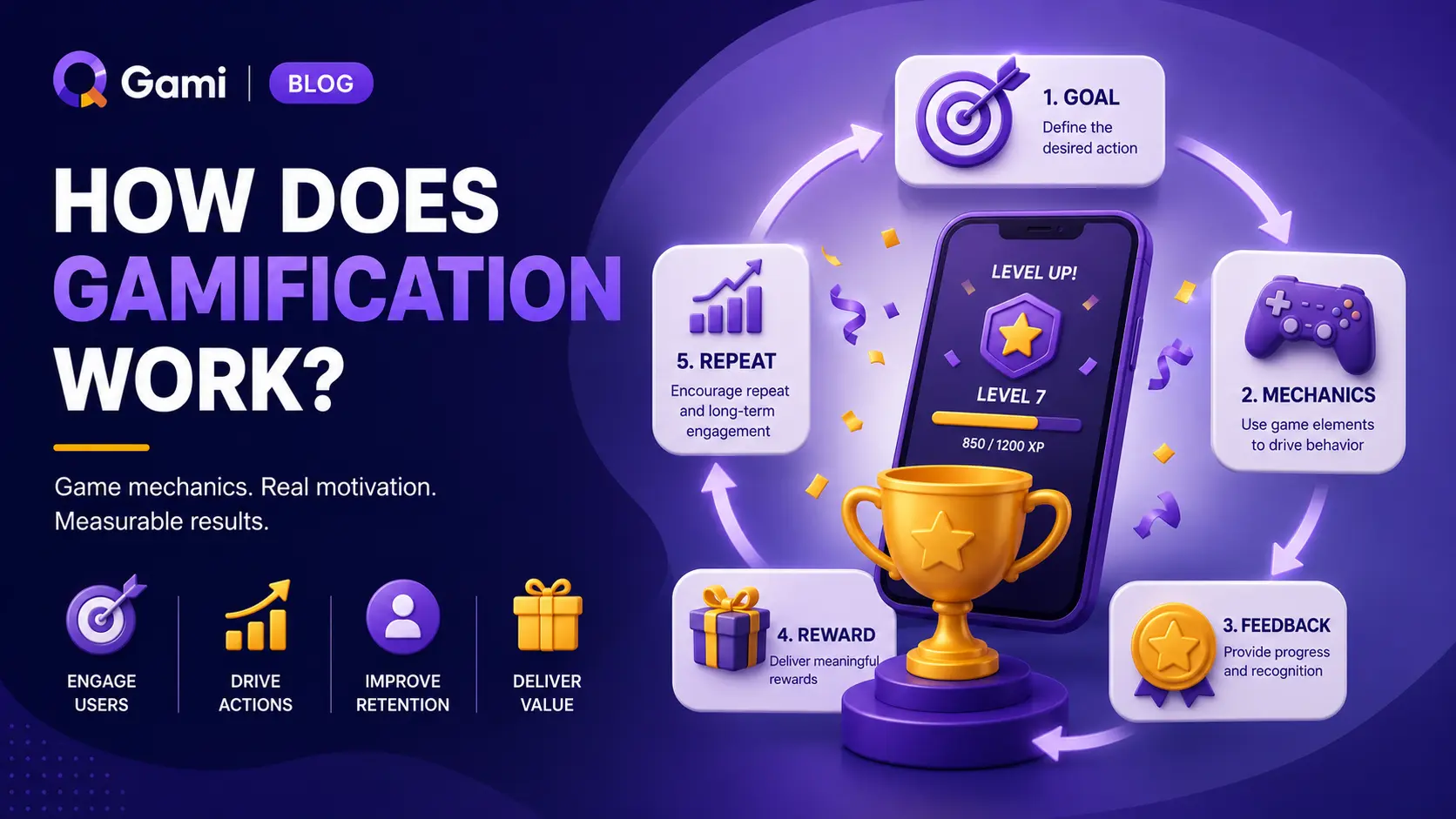
🎮 How Does Gamification Work?
Gamification is the application of game design elements to real-world activities to motivate and engage users.
It works based on a combination of psychology and engineering:
1. The PBL System (Core Mechanism)
Most gamification systems revolve around the "PBL" trio:
-
P (Points): Instant rewards for each correct action, helping users see the value of what they have just done.
-
B (Badges): Achievement recognition based on milestones, appealing to the desire to collect and show off status.
-
L (Leaderboards): Creates social competition, motivating users to strive harder to avoid falling behind.
2. Feedback Loop
Gamification retains users through a continuous loop:
-
Challenge: Present a manageable task (not too easy to get bored, not too difficult to get discouraged).
-
Action: The user completes the task.
-
Feedback: The system provides immediate feedback (displays a congratulatory message, adds points, sound effects).
-
Reward: Receives benefits (gifts, special privileges, or recognition).
3. Psychological Motivation (Octalysis Framework)
Gamification exploits natural human needs:
-
Sense of Progress: Seeing oneself progressing through levels.
-
Ownership: Accumulating virtual items or assets within the application.
-
Scale: Events only last for a short time, prompting quick action (FOMO).
-
Curiosity: Unlocking hidden features or rewards.
💡 Typical Examples
| Field | Application |
|---|---|
| Learning | Duolingo: Learn a foreign language by maintaining a "Streak" (a series of study days) and competing for rankings. |
| Health | Strava: Turn running into a virtual race with friends. |
| Commerce | Shopee: Play games involving watering plants and raising pets to earn real discount vouchers. |
What gamification✦✦ solution are you looking for?
We are ready to advise the most suitable solution for your business model.